Post·4d ago
Gemini, copilot
31 answers
Gemini, copilot
Most of my side projects used to end at a dashboard. Pretty charts, a Power BI file, a few numbers nobody acted on. Lately I've been using Claude and Codex to get past that point.
At my current company I built a corporate emission BIN simulator that the Strategic Planning team and the Executive Board actually use. With AI tools handling the scaffolding and data plumbing, I could spend my time on what matters: regulatory limits, cost curves, what a 2028 contract renewal means for our plants.
The test I use now is simple. Can someone make a decision with it? If not, it's still a dashboard.
I use ChatGPT and Perplexity the most. I use ChatGPT to brainstorm ideas, work through coding problems, refine my writing, and prepare for interviews. I use Perplexity to research companies, explore technical topics, and find sources I can review in more detail. I treat both as tools to support my thinking rather than replace it, checking important information and making sure I understand the outputs before using them.
I use Claude Code almost every day now, and one of the first real things I built with it was an app for a local church. They had a spreadsheet with about 3,000 people in it, and it needed to get into an online tracking system their grant reporting runs on. Doing that by hand was not an option.
Claude Code handled the messy parts: cleaning up the columns, matching records, and writing the import logic so the data landed in the right fields. I still checked every step, because a grant report built on bad data is worse than no report.
I also lean on Claude for research and ChatGPT for a second opinion on drafts and numbers. Different tools, different strengths. What I've found is that the work goes fastest when I stay the one deciding what's true.
* Claude (Claude Code incl.)
* Magnific
* Instinct
* NotebookLM
* Make
I use AI as both a creative tool and a workhorse for daily tasks. It helps me generate ideas, refine concepts, and shape narratives in ways that weren't possible before. What excites me most is the expansion of what's possible in design—problems I'd have spent weeks on now have a different path forward. The constraint isn't the tool anymore; it's imagination.
Cursor is my main editor, and I lean on its cloud agents to run work in parallel. In the terminal, I switch between Claude Code, Codex CLI, and Grok Build depending on the job, using Orca and sometimes even OpenCode with open-source models.
Beyond coding, I run a team of AI agents that handle engineering, go-to-market, and ops work for my own products. I built MCP servers with OAuth 2.1 for FeedJolt and Corvidly so agents can work with those products directly.
I also trained a small language model with a playbook, and I use AI checks in CI/CD for code review and cleanup, guided by my own clean code, DDD, and TDD skills. I use AI to code, review, secure, and document, and I still write production code myself.
I am a heavy user of Claude and Claude Code, supplemented by ChatGPT/Codex and Gemini.
I test AI features of other tools I regularly use and determine if they meet my standards - some do, others are worse than doing things yourself. If AI features add value and save time, I'm in.
I primarily use Gemini and the tools available through its business subscription. I am trying to become more proficient at google gemini studio and antigravity
Codex and Claude are the tools I use most for building. I used them to create Sandbox's internal acquisition CRM: translating a corporate-development workflow into a working platform that supports outbound sourcing and deal management for three colleagues.
My starting point is the problem, the users and the acceptance criteria. I use AI to move faster through implementation and iteration, while keeping ownership of the business logic and the quality of the result.
I'm especially interested in the overlap between AI, learning and practical operations. At Kiroku Notes, I built an AI-enabled learning platform around spaced repetition, adaptive difficulty and gamified progression. My studies in data science, machine learning and NLP help me connect the tools to the ideas behind them.
I build with Claude and Claude Code every day, and run ChatGPT and Codex in parallel for research, writing, and coding. AI is central to how I ship now — from drafting and design to writing and shipping product features.
Opencode - coding agents, also inside IDE (TRAE, RooCode, Cursor).
I like Google's Stitch for prototypes, Leonardo and Ideogram for graphic design.
Claude code, Hermes, and T3 code
Claude (Claude Code): My daily operating system. I built an AI chief of staff on it that runs my calendar, notes, follow-ups, research, and content production from one connected knowledge base.
ChatGPT and Codex: Drafting, research, and building workflows. I run them alongside Claude, and the system is set up so my context carries over from one model to the other.
Granola: AI meeting notes. Every call gets captured, summarized, and fed into the system so nothing gets lost.
I use a combination of AI tools for strategy, operations, sales, customer support, development, testing and deployment - and also as a PA in my personal life. Today, it's mostly Grok Bot, Claude and Codex.
I also built our own proprietary harness for biomedical research based on our knowledge graph, which we use to demonstrate our products' capabilities and identify business opportuntiies.
Claude code - I use it daily for GTM, our recruiting processes and improving our own tool
Everything is changing so often I find myself switching a lot. At this exact moment Claude Cowork / Code are my daily drivers - I still main cursor as the IDE environment even when working with claude code desktop and TUI though.
Ollama / llama.cpp for a bunch of little tasks fed through my homelab, actively experimenting with opencode.
I use claude the most by far, I have an enormous obsidian vault with everything needed to run my day to day tasks via cowork and use claude code and design to ship products for my design agency Suada
The spirit of GifBook has always been creation.
With all the AI slop flying around, I think we're forgetting some of the magic. The magic of animation. The absolute miracle that is the meme. And, let's face it, the undeniable awesomeness of a printed flipbook.
So I mashed all three together and built my dream app: GifBook Studio.
This is literally the app I searched for COUNTLESS hours trying to find when I was in art school. It didn't exist. So I built it.
The FREE forever version of GifBook is already on my website. Make a flipbook, print it locally, cut it out, and watch your animation come to life in your hands.
But GifBook Studio? That's the one I'm actually excited about. Coming to iPhone with local printing, cloud printing, and basically everything I wish existed when I was broke and caffeinated in design class.
Built for animators, artists, meme makers, kids, teachers, and anyone who just wants to make something ridiculous move.
GifBook turns your favorite GIF into an actual flipbook you can hold. Seriously. Open it in your browser, watch the preview, and boom—free PDF ready to print at home. Grab scissors, grab tape, pretend you're crafting something artisanal. When you're tired of DIY and want the real deal, we'll print and bind them in packs of five with shipping included across the US and Canada. Customize covers, titles, whatever. Your file stays on your computer until you actually commit to an order.
www.mrbray.com/gifbook
When possible, I supplement my workflow with ChatGPT and Claude the most to maximize efficiency across projects in my career:
California HR Compliance Project: researched regulations, interpreted requirements, built supervisor checklists, and created bilingual documentation.
SAGE Companion Launch: conducted customer research, developed marketing strategy, managed outreach, ran user testing, and coordinated advertising.
Compensation Analysis: analyzed role requirements, benchmarked market rates, compared geographic data, and delivered recommendations.
Consulting Case Development: framed client problems, built analytical frameworks, developed recommendations, mapped implementation steps, and prepared presentations.
Business Development: identified prospects, built contact databases, mapped partnership opportunities, and structured outreach campaigns.
When I can automate synthesis or documentation, I do. It frees me to focus on the work that actually moves projects forward.
I've been fun of Notion, Anthropic and Perplexity for some time. Claude Cowork allows to develop, customize and apply legal plugins. Perplexity helps with the research. Notion is my favourite app for daily operational job of managing team, tracing contracts, running controls and making Wikis.
Left Aon in 2019 and launched an eCommerce platform for preventive health, managing 30+ contractors. After two years tryin to building a legal tech startup from 2022, while also pursuing a legal trainee contract and funding for a legal degree at BPP where I had been admitted.
The years 2024 and 2025 got rough, living in hostels between short term leases, because renting in a flatshare as a freelancer without an employment contract is very challeng in London. Yet, I learned to code in Python, JS, HTML, tested AI tools.
By spring 2026, I ditched library PCs (the pain of walking miles with back issues wasn't worth it) and switched to AI-only workflows on minimal hardware. Now I build with Vercel, Replit, and Claude.
Left Aon in 2019 and launched an eCommerce platform for preventive health during the pandemic, with 30+ contractors and solo-led work on Wix AI Design, Canva, Figma, Notion. Then ChatGPT dropped and from 2022 I spent 2 years trying to build a legal tech startup, while pursuing a trainee contract and degree.
2024 and 2025 were rougher, living in backpacker hostels between short term rentals, due to the challenge of renting as a freelancer.
Yet in 2025 I learned to code in Python, JS and HTML from Grok and Copilot, and tested many AI tools: ElevenLabs, Hedra, Kling, Veo, Flow and Stitch by GLabs, Seeedance, Flux, Hunyuan, Wan. Claude for data visualisation and code.
Then from autumn 2025 to spring 2026 I had to suffer unnecessary enormous physical pain due to walking miles to libraries to use Tableau and Adobe online on time-limited PCs
At the end by spring 2026 I quit the libraries PCs, and I opted for AI-only workflows and agents in Vercel, Replit, Eleven Agents, Wabi & more, that run on tiny hardware
Lately Codex, Antigravity, Gemini, ChatGPT, evolv3 Multi-Agent OS (powered by OpenClaw).
Claude and Codex
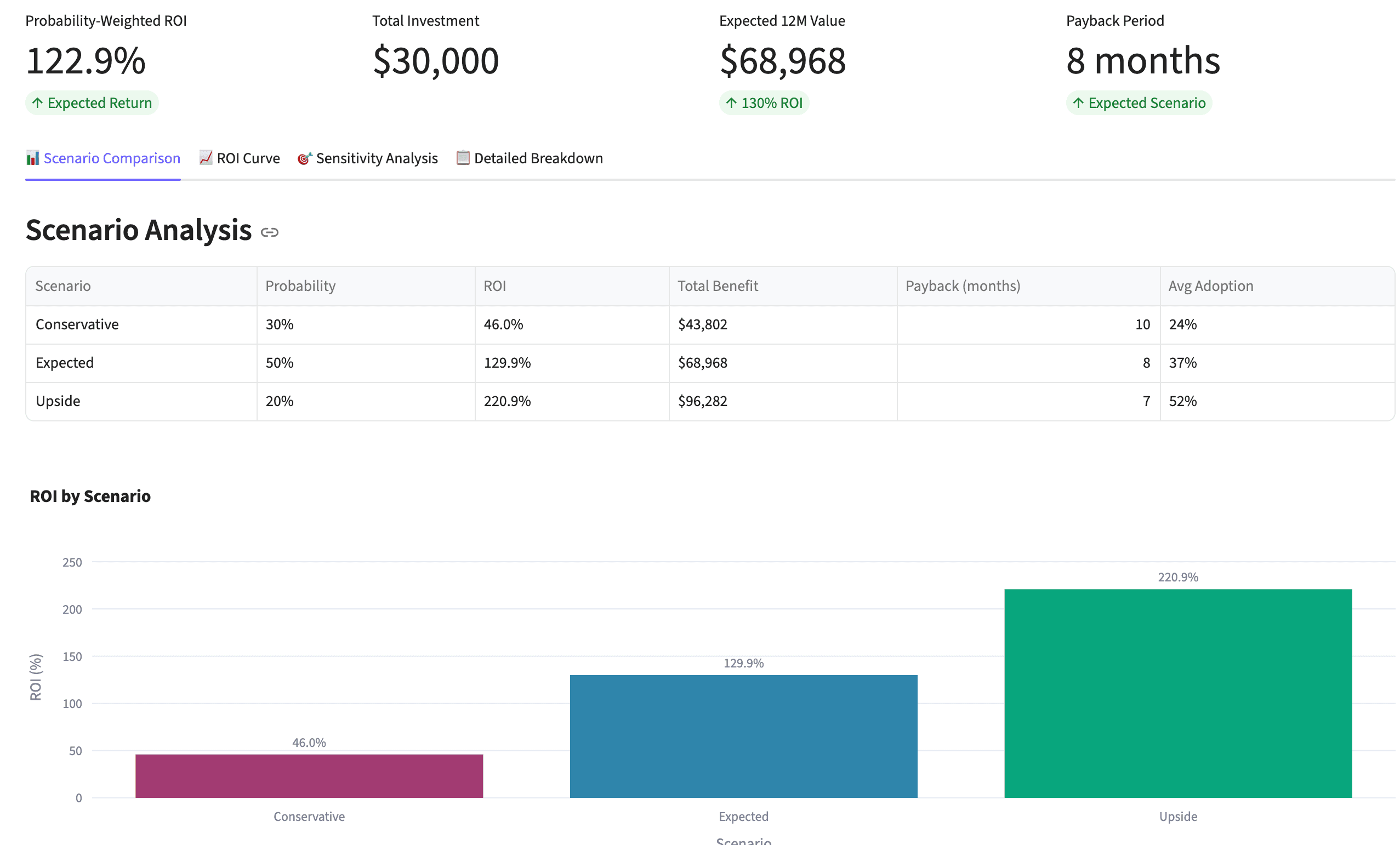
English final recommendation Designed and built a scenario-based ROI prediction framework to help Anthropic’s Startup Ecosystem and Account Management teams evaluate the expected impact of Claude API credits. I defined the core decision variables—including API credit value, implementation cost, annual task volume, time saved per task, labor cost, automation potential, and expected adoption—and translated them into an interactive decision-support tool. The model generates probability-weighted R
Open link
For decades, centralized media smoothed over differences. Shared programs, shared headlines, and mass-market narratives created the appearance of one common culture. Averages hid the extremes, while smaller identities and subcultures remained largely invisible. Algorithms did not manufacture every preference from nothing. They observed what we paused on, reacted to, and shared—and amplified the most emotionally dense signals. What now looks like fragmentation may partly be higher resolution. The differences were already there. The algorithm removed some of the blur. Of course, algorithms are not neutral mirrors. Repeated amplification can also shape preferences, intensify conflict, and push people further toward the edges. But the strategic implication remains clear: Trying to appeal to everyone often produces a message that matters deeply to no one. The future belongs not to the loudest message, but to the one that understands its audience with the greatest precision. Mass appeal searches for the average. Meaningful engagement understands the edges. So the question is not simply: “How do we reach more people?” It is: Who exactly are we trying to reach—and why should they care? ShorterLongerFunnierRewrite
claude, figma, notion, gemini, grok
Claude Code is my main dev environment now. I've built a harness workflow on top of it that lets me prototype faster, and an automated testing framework that catches issues before they become problems. But the real win was creating a personal knowledge base to track tasks, progress, and what I actually learn from each project. It's become the connective tissue between how I code and how I think about what I'm building.