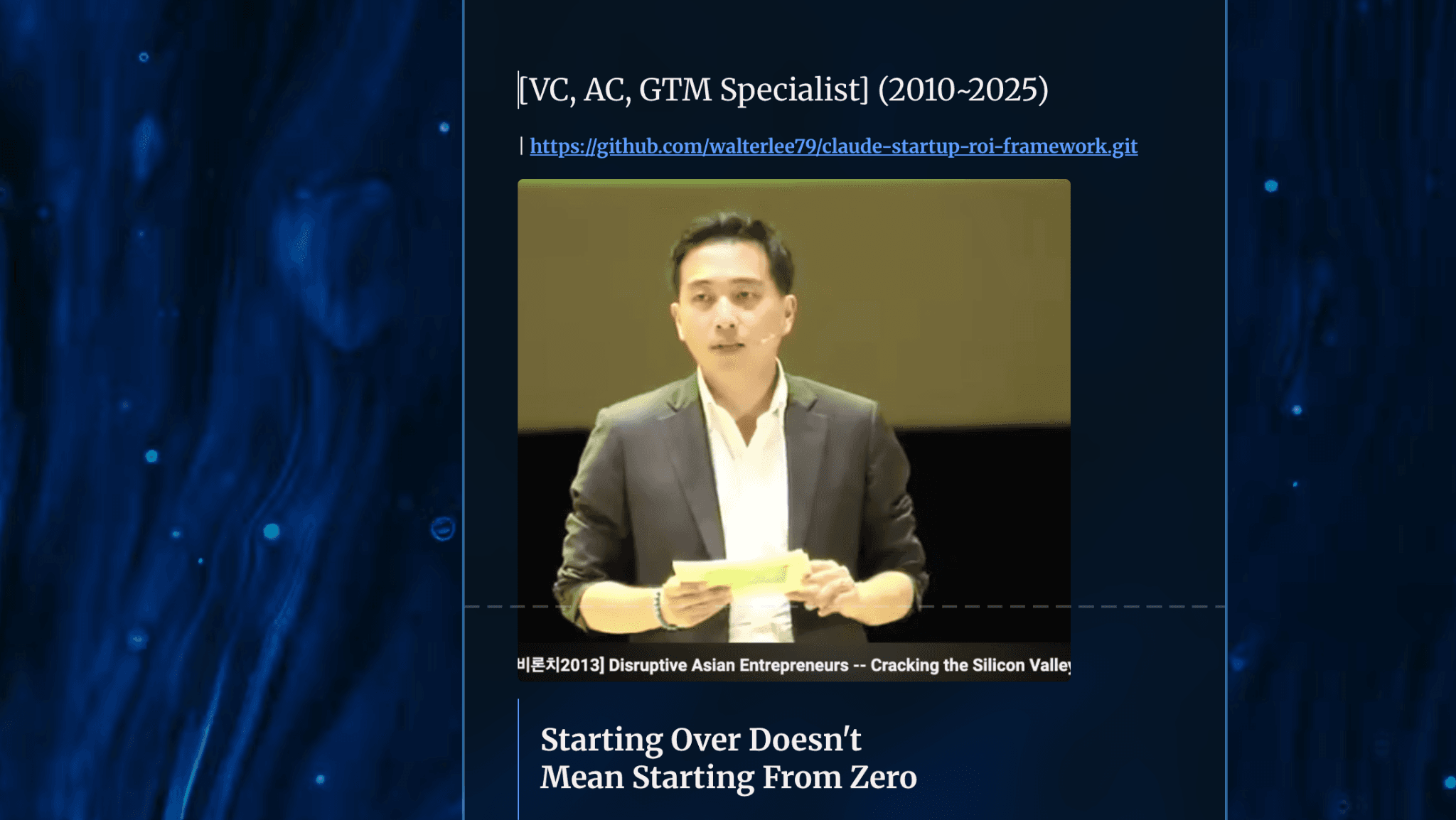
Starting Over Doesn't Mean Starting From Zero
We're All Entrepreneurs — The Power of Compounding, Another Day One, and the Courage to Begin Again
Hanjong Lee · GTM & Evidence Builder · November 2026
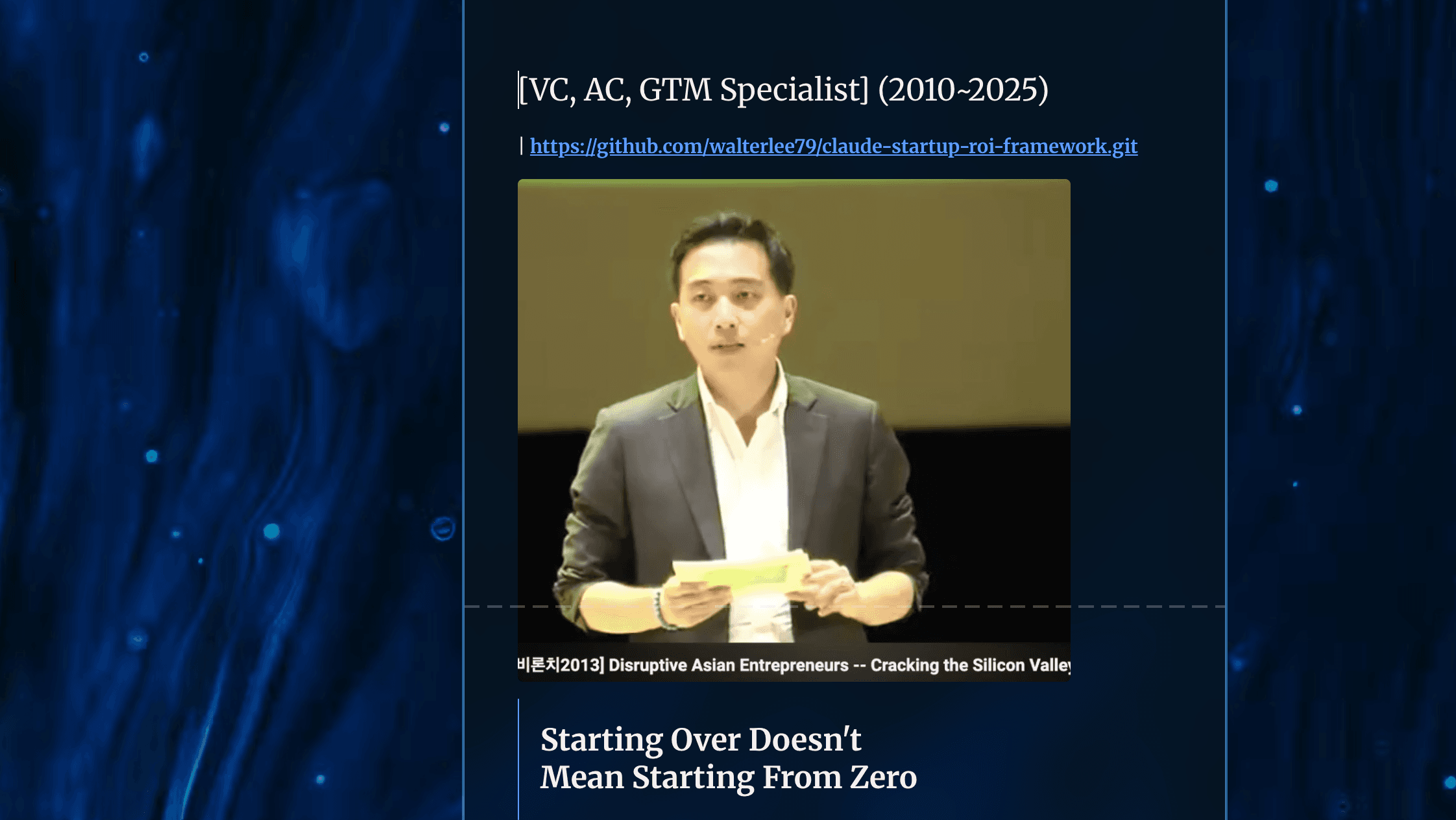
1. An Old Question Returns
This fall, I left my company.
Starting over isn't new to me. Over the past 15 years, I've worked across film, content, startup ecosystems, global business expansion, and AI technology sales. Moving between Korea and the United States, I've spent much of my career connecting founders with investors, technology with markets, and ideas with opportunities.
But this time felt different.
Without a company name or job title, I found myself asking a simple question.
After all these years, what have I actually become better at?
It reminded me of something I wrote many years ago.
That essay began with an idea from Muhammad Yunus: We are all entrepreneurs.
Inspired by The Start-Up of You by Reid Hoffman and Ben Casnocha, I explored the idea that people have a natural ability to create opportunities, shape their own lives, and build something valuable.
At the time, I argued that we had been trained to become good employees, but not necessarily to take charge of our own lives.
We learned to find the right answers, compete to stay ahead, and follow the paths that society considered successful.
But somewhere along the way, had we become more comfortable choosing from existing opportunities than discovering our own potential?
I wasn't suggesting that everyone should start a company.
There is real dignity in work. Building expertise, doing your job well, and earning trust over many years are things worth respecting.
The problem wasn't being an employee.
It was forgetting that we still have a voice in choosing how we work and live.
Back then, I also questioned how society often placed too much responsibility on individuals.
When education and employment systems failed to create enough opportunities, it seemed unfair to simply tell young people to lower their expectations or work harder.
I still believe that matters.
We are responsible for our choices, but not every failure comes from a lack of effort. Opportunities are not equally available, and not everyone can afford to take the same risks.
So entrepreneurship should mean more than telling people to be brave and take chances.
It should mean understanding our circumstances, taking risks we can manage, and discovering what we can become through change.
Back then, I called it the journey of finding our own North Star.
Many years have passed.
And now, in the fall of 2026, I find myself at another starting line, facing that old question from a different place.
What have I built so far, and what can I build with everything I've learned?
2. A Third Day One, and One Common Thread
Around the same time, I read an essay by CK (Chang Kim).
After selling Tapas, CK took a sabbatical. He could have retired or continued as an investor.
But he noticed something interesting.
Whenever he met founders, he found himself thinking more about the products they were building than the investment opportunities in front of him.
He put it simply.
"Builders gonna build."
People who love building things will eventually find themselves building again.
So CK started his third company.
"So here I am. Back at 0 to 1 in founder mode."
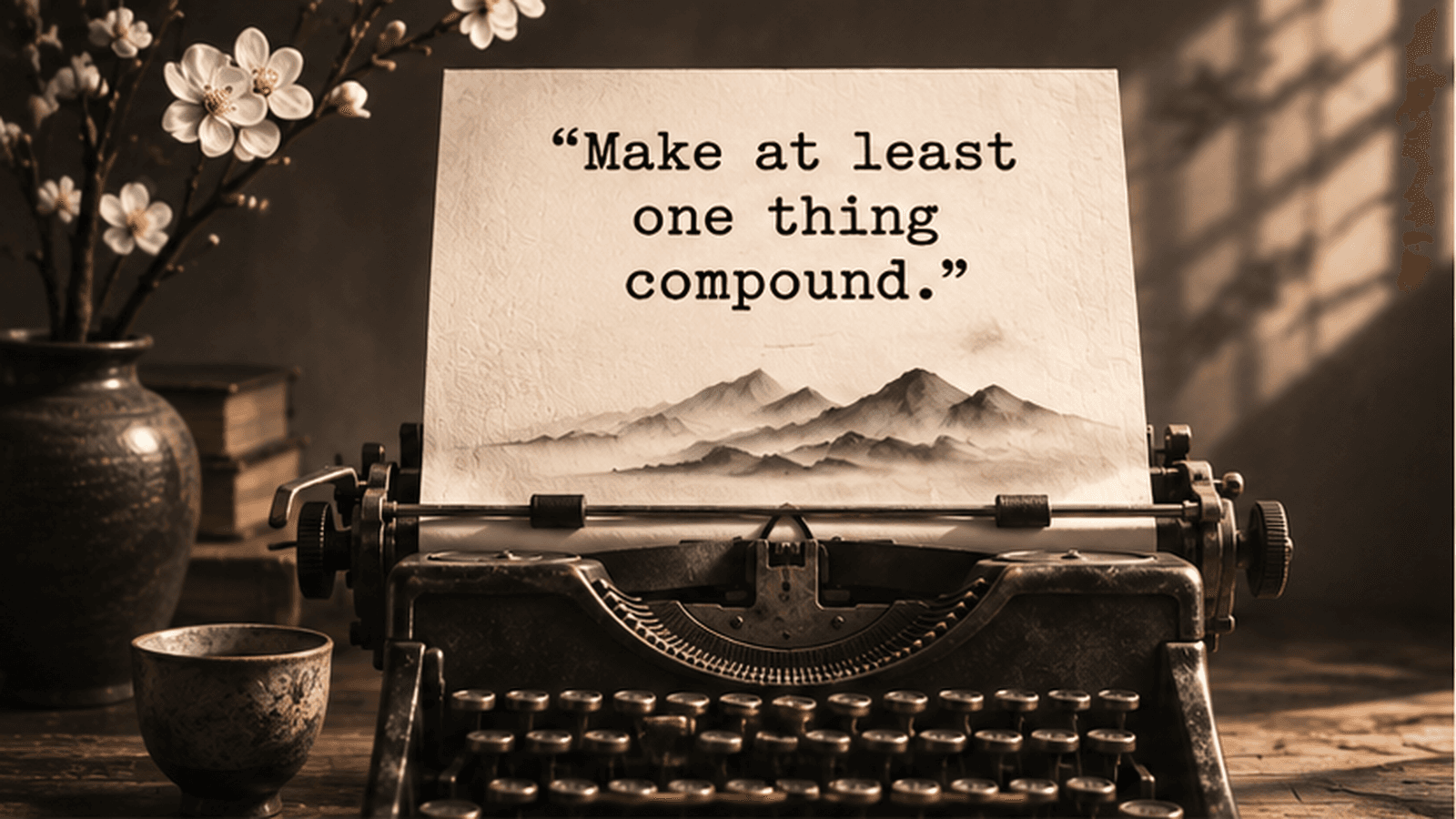
< "Make at Least One Thing Compound., CK">
He was back to building something from zero.
That line stayed with me.
It didn't sound like someone promising another great success. It sounded like someone realizing that the desire to build had never really left him.
In another essay, CK reflected on Warren Buffett and Larry Ellison.
They had spent decades becoming exceptionally good at what they did. Over time, their knowledge, judgment, relationships, and trust had grown stronger.
Like compound interest.
But CK's own career had followed a different path. He had built companies in different industries and moved between founding and investing.
So he asked himself:
"What compounded along the way?"
What had actually grown through all those years of change?
I started asking myself the same question.
I began with an interest in storytelling. Later, I wrote about startups, connected founders and investors, supported international business expansion, and helped companies explain the value of new technologies.
For years, I saw these as separate parts of my career.
But looking back, I noticed one question that kept returning.
How can we turn the value of good people and good technology into something others can understand, trust, and choose?
In 2016, I wrote about Amazon's Flywheel and network effects.
Later, I heard that the article had helped inform an investor's thinking.
I didn't make the investment or build the company. But I learned that something I had written could help another person make a decision.
At Polymerize, I worked on explaining how AI-driven materials technology could help customers solve real R&D problems.
The people developing a technology and the people helping the market understand its value play different roles.
I learned how important it is to understand both sides and connect them.
This summer, I published 100 posts on Saywise over roughly two months.
Through writing, videos, company research, and product strategy, I began connecting experiences that had seemed unrelated for years.
And somewhere in that process, I found a name for what I had been trying to do.
GTM & Evidence Builder.
Someone who helps turn the value created by people and technology into clear stories and evidence that others can examine and trust.
Maybe I hadn't been moving randomly from one field to another.
Maybe I had been working on the same question in different environments.
CK wrote:
"Maybe it's not your job, project, or company that compounds. Maybe it's you, the person."
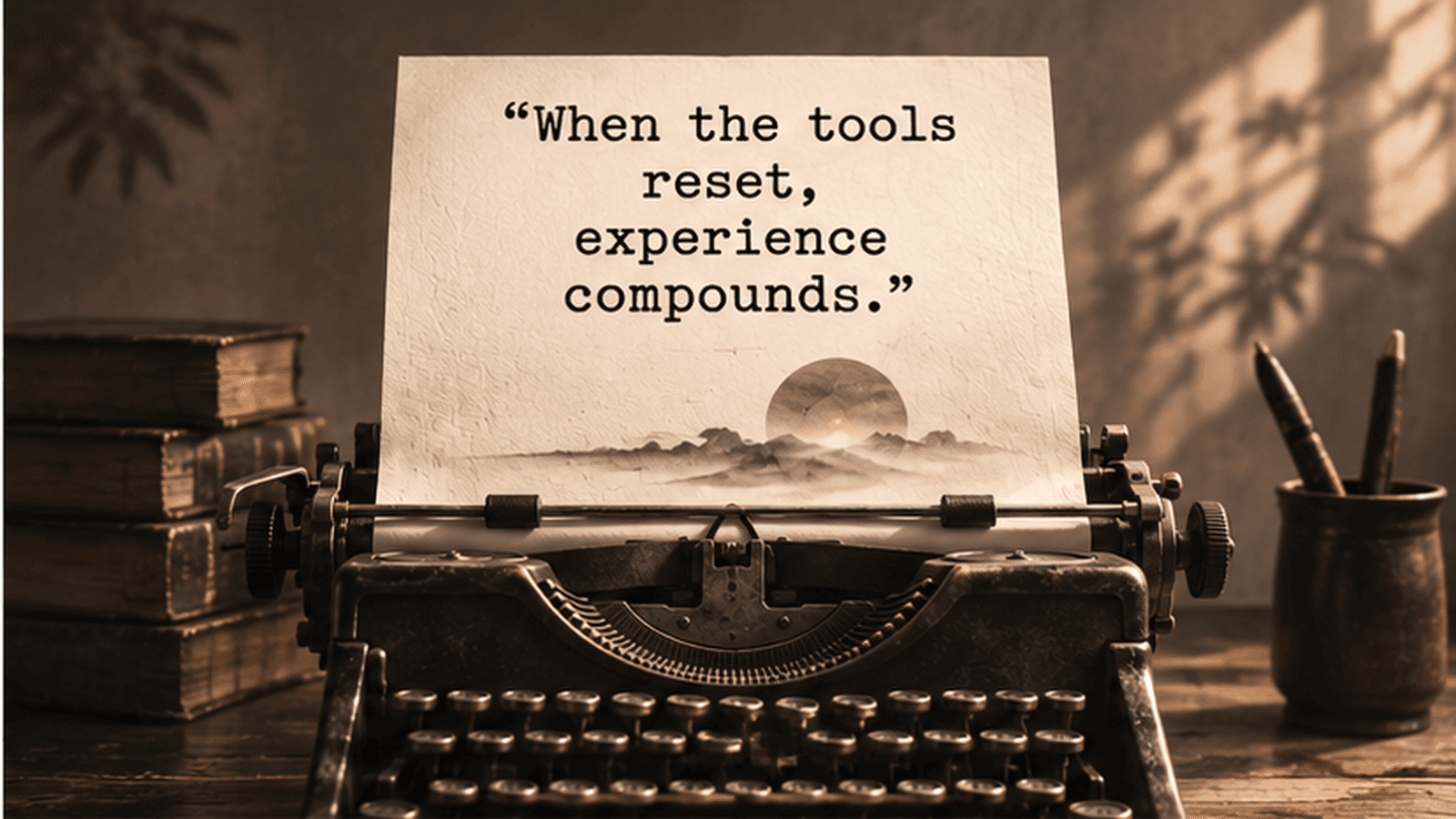
<"When the Tools Reset, Experience Compounds. CK">
Perhaps what compounds isn't the company or the project.
Perhaps it's the person who lived through all those experiences.
That thought changed how I looked at my own journey.
It also brought me back to the idea of finding a North Star.
Maybe finding our direction doesn't always mean discovering a perfect purpose before we begin.
Maybe it's about recognizing the questions we keep coming back to, even as our jobs, industries, and circumstances change.
We don't always find our North Star before starting the journey. Sometimes we only recognize it after looking back at the road we've traveled.
3. Not Every Experience Becomes Growth
But I can't say that everything I've done over the past 15 years has compounded.
Some choices may have taken me away from better opportunities. If I had stayed longer in one field, I might have developed deeper expertise.
Working hard doesn't always mean creating meaningful results.
Meeting many people doesn't necessarily mean building trust. Working across different projects doesn't make someone an expert in every field.
And 100 posts don't mean 100 proven achievements.
There are still things I need to learn, improve, and prove.
That's why I don't want to use compounding as an easy way to make myself feel better about the past.
Experience doesn't automatically compound just because time passes. It compounds when what we've learned changes what we do next.
What did I learn from failure?
What was my actual contribution to a success?
What should I keep, and what should I let go of?
When we can answer these questions honestly, our past can become something useful for the future.
Reid Hoffman explains that our competitive advantage comes from the intersection of three things: our assets, our aspirations, and market realities.
I understand those ideas more clearly now.
Just because I love doing something doesn't mean the market will value it.
And just because the market needs something doesn't mean it's what I want to do for the rest of my life.
Experience alone doesn't guarantee that I'll remain competitive in a changing market.
What matters is continuing to find the place where what I've learned meets what the world actually needs.
That also means being willing to question myself.
Does what I believe I'm good at actually help others?
Is the problem I care about really worth solving?
If someone values my work, what evidence supports that belief?
Without asking these questions, experience can remain nothing more than a collection of memories.
With honest reflection and real feedback, it can become something that helps create new possibilities.
This year also changed how I think about growth.
Unexpected changes in life reminded me that sometimes taking care of family and protecting everyday life matter more than professional progress.
I used to think growth meant moving higher, achieving more, and proving myself.
Now I understand that sometimes staying where you are, accepting help, and slowly returning to everyday life are just as important.
Not every season of life needs to be measured by achievement.
But the things we learn about what truly matters can shape the choices we make next.
My understanding of compounding has changed, too.
It's no longer only about what I've gained or how much I've achieved.
It's also about who I've become along the way, and whose growth I might be able to support next.
Maybe that's where human growth becomes something deeper.
4. AI Is Giving Us Another Starting Line
CK once believed that older founders didn't belong in tech.
AI changed his mind.
"When the tools reset, experience compounds."
When the tools change, the experience we've built over time can become even more valuable.
I find this idea encouraging, but I think it comes with an important condition.
Experience doesn't automatically become a competitive advantage just because new technology arrives.
We also need to be willing to let go of old habits and learn again.
AI can help us write, code, analyze information, and build products.
But we still need to decide what is worth building, which results we can trust, and how our work can help others.
Years of experience can help us make those decisions.
Still, we need to test whether what worked in the past is still useful today.
This brings me back to The Start-Up of You.
Reid Hoffman introduced a flexible career strategy built around Plan A, Plan B, and Plan Z.
Plan A is what we're doing now.
Plan B is the direction we can move toward when new opportunities appear or our current path no longer works.
Plan Z is the safety net that helps us recover if things go wrong.
I still find this approach useful for one simple reason.
Because we can't predict the future perfectly, we need to get better at changing our plans, not just following them.
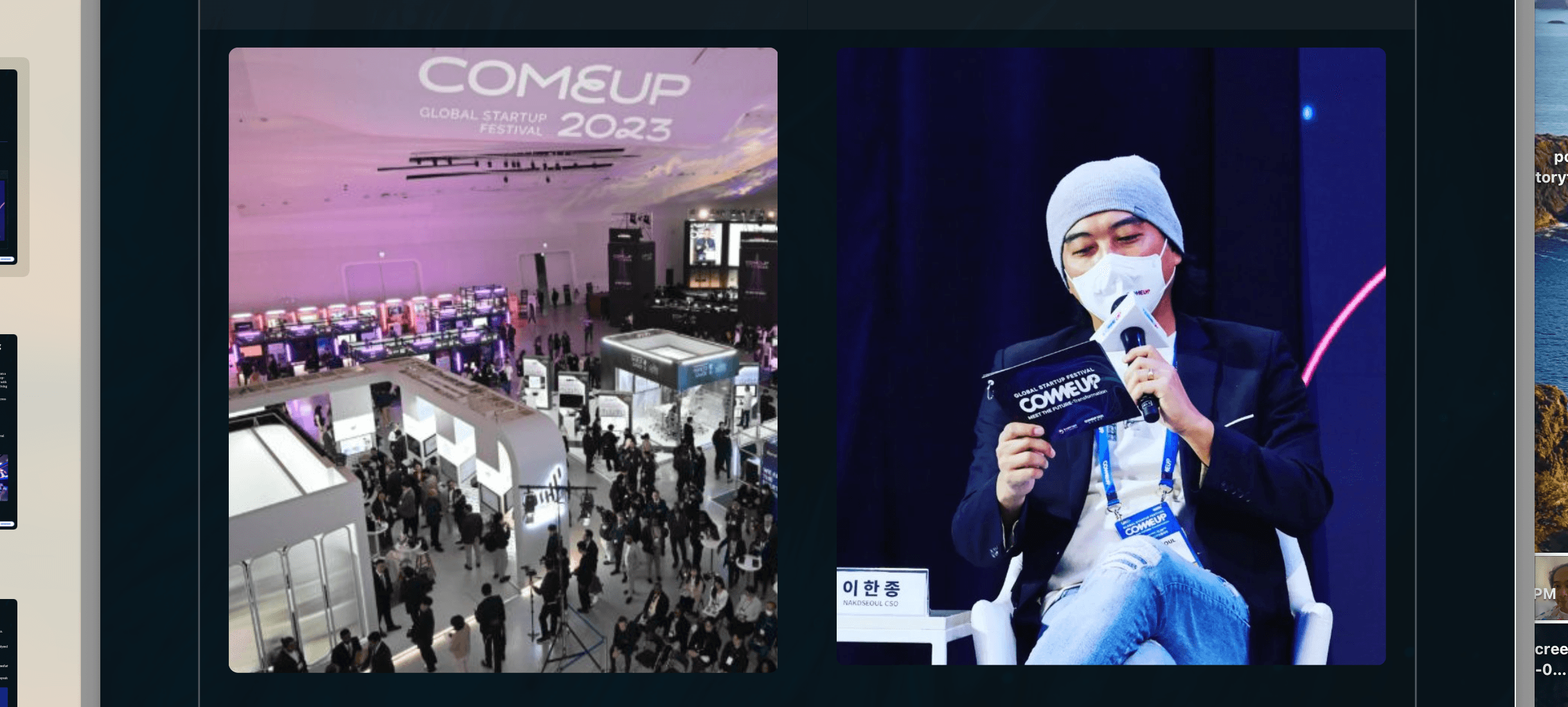
<comeup2023>
But I also believe that adapting to change shouldn't become another source of endless pressure.
For a long time, society encouraged people to compete by making them afraid of falling behind.
Now, in the age of AI, we may face a new version of the same pressure.
Learn every new tool. Keep reinventing yourself. Move faster, or you'll be left behind.
I don't think that's the right answer.
Not everyone can move at the same speed, and not everyone can afford to take the same risks.
Sometimes protecting the life we already have matters more than chasing the next opportunity.
So real adaptability isn't just about moving faster.
It's about knowing what needs to change and what is worth protecting.
Maybe the future isn't about choosing between youth and experience.
Maybe it's about combining two things.
The courage to become a beginner again, and the judgment we've gained from years of experience.
That's something I want to keep exploring.
I want to use new tools to question what I thought I knew, look at old problems differently, and try approaches that weren't possible before.
And as AI takes on more tasks, I want to think even more carefully about what matters to people and which decisions we should remain responsible for.
To me, that's an important part of the entrepreneurial mindset.
Entrepreneurship isn't always about starting a company. It's also about staying in charge of the choices that shape our work and our lives, even as the world changes.
5. Another Day One
CK ended his reflection with these words.
"There's no age limit on day one."
He also promised to share what building from zero really looks like, including both the good moments and the humbling ones.
I especially liked that last part.
Starting over isn't always exciting.
Sometimes it means admitting how much we don't know.
Sometimes the results disappoint us.
Sometimes the experience we thought we had isn't enough for a new challenge.
And still, we choose to learn and build again.
Maybe that's an important part of the builder's mindset.
Many years ago, when I first read Muhammad Yunus's idea that we are all entrepreneurs, I believed we should take more responsibility for shaping our own lives.
Back then, I saw entrepreneurship as the courage to face change and create new opportunities.
Today, I see another side of it.
Being the entrepreneur of your own life doesn't mean you have to do everything alone.
It means being honest about your circumstances, accepting help when you need it, and asking yourself what kind of work and life you want to build.
And when your answers change, having the courage to change your direction, too.
Today, I'm not announcing a new company.
I'm simply looking for my next role and direction while trying to understand what value my experience can create.
I have people I've worked with, things we've built together, lessons from decisions that didn't go as planned, and records of what I've learned along the way.
I don't know yet where those things will lead.
But one thing has become clearer.
I want to keep discovering good people and good technology, and helping others understand and trust their value.
And if possible, I hope what I've learned can help someone else find a new opportunity, too.
CK wrote:
"Hopefully I compounded."
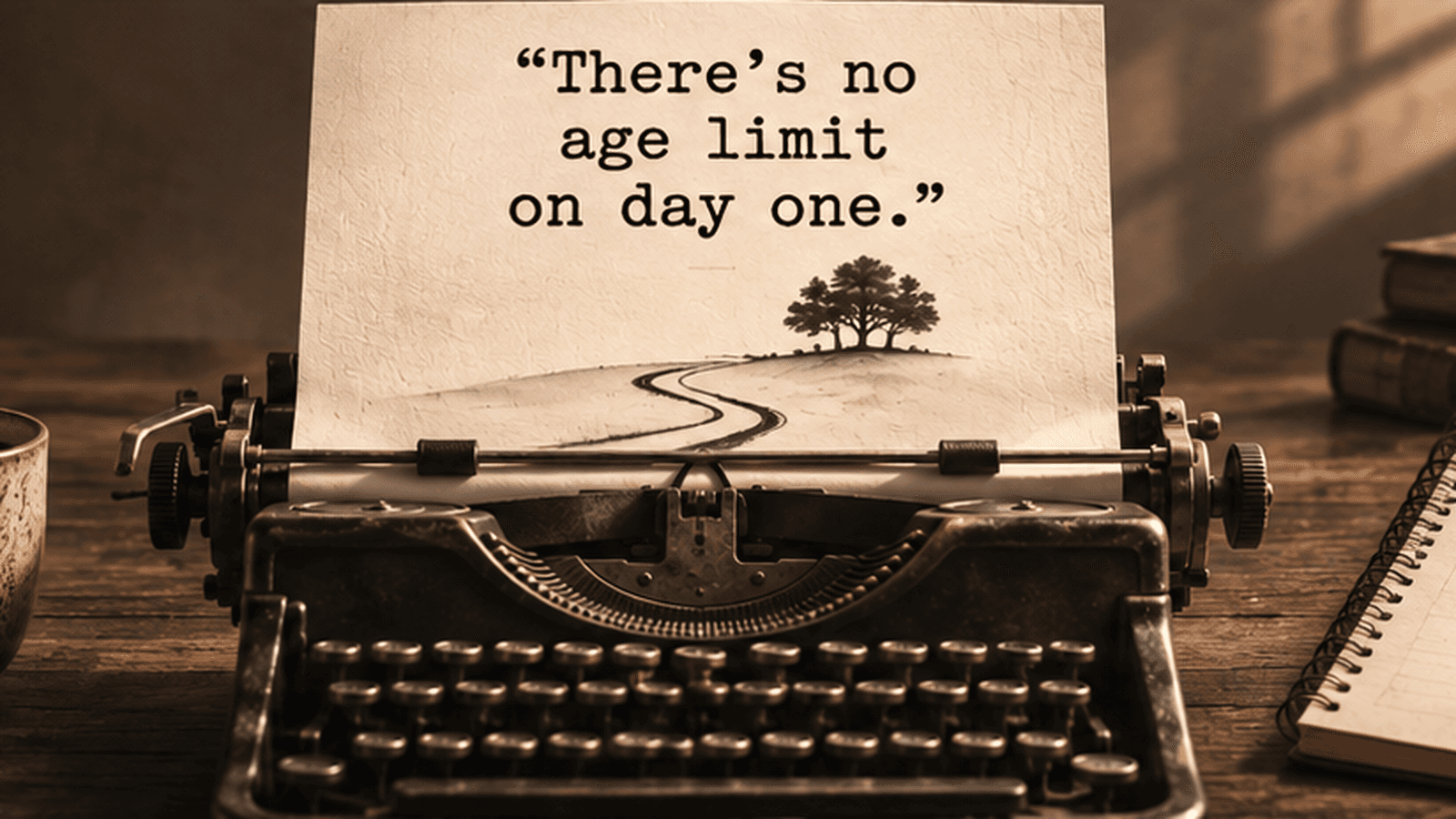
<"There's No Age Limit on Day One. CK">
I want to borrow that line.
I can't say every choice I've made over the past 15 years was the right one.
But I've learned things. I have people who have supported me. And there are still things I want to do.
Maybe that's enough reason to begin again.
Every company may start from zero. But the person building it doesn't have to.
There's no age limit on day one.
And day one doesn't always mean starting from nothing.
Sometimes it simply means taking everything life has taught you and choosing to learn again.
Many years ago, I wrote that we needed to rediscover the entrepreneur within ourselves.
Back then, I thought that meant finding the courage to shape our own lives.
Today, I'd like to add one more thought.
It's not just about discovering our own potential. It's about using that potential to create new opportunities for others, too.
Maybe that's the North Star I've been searching for all along.
Make at least one thing compound.
Let that thing be you.
And let what you've learned help someone else begin.
Hanjong Lee
Inspired by CK (Chang Kim)'s reflections on starting over and compounding, and Reid Hoffman and Ben Casnocha's The Start-Up of You.