
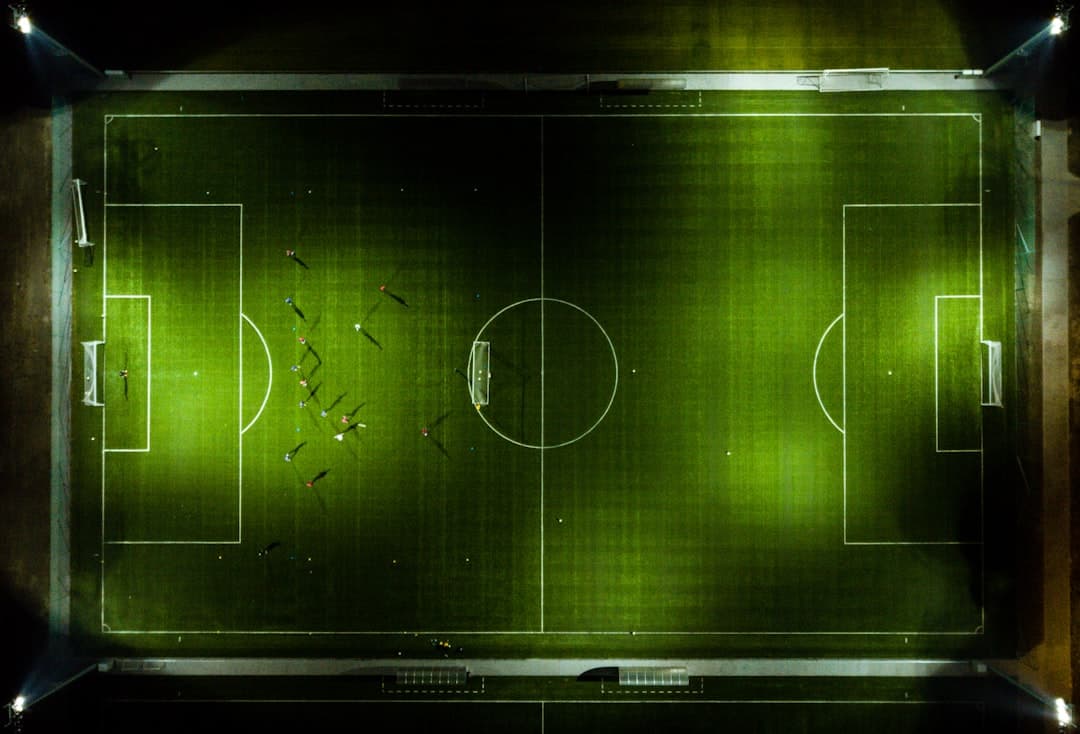
My Monday football team wanted a Veo. Then somebody looked up the price: Veo bills New Zealand and Australia in Australian dollars, so it's A$2,149 for a Cam 3, before the annual subscription. That ended the conversation. So I went looking for the cheap version, and found it. Andever, out of Korea, does the thing I had been picturing: two or three ordinary phones instead of a camera, and software does the rest. It's in Korean, which I read fine. I still couldn't use it, because they operate in Korea and I'm in Auckland. What the heck, I thought. I'll build it myself. The software I knew how to start. The rig I did not, and nobody sells one. I went through camera shops here, then Temu and AliExpress, hesitating over cheap listings because half of them never ship. Every product held two phones flat side by side, or one phone at any angle I liked. Never two phones angled apart. What exists instead is studio lighting hardware: a stand built to hold a softbox four metres up, and a bracket built to carry two flashguns. I ordered a NEEWER SP-08 and waited two weeks. While it shipped I put one phone on the stand and recorded three quarters of a real match, which settled a question I had been avoiding. One ultra-wide lens does not see a whole football field, and a player at the far corner is a smudge a few pixels across. So it's two phones, on a bar at the halfway line, each covering half the pitch with about a quarter of the middle overlapping. That overlap is the trick: it lets a pipeline line the two files up after the match and stitch them into one image. Nothing gets decided at the pitch, which is the part I like. A motorised mount has to guess right while the game is happening, and a wrong guess is gone for good. Both phones record true 3840×2160 now and one match has been through the pipeline. The first bar was plastic and bent under their weight, so the two horizons never met. A 27 cm metal flash bracket arrived last week. I am now getting quotes on 3D printing, which I did not see coming.